Employee Management
From 20 to 200 Employees: How HR Management Needs to Change
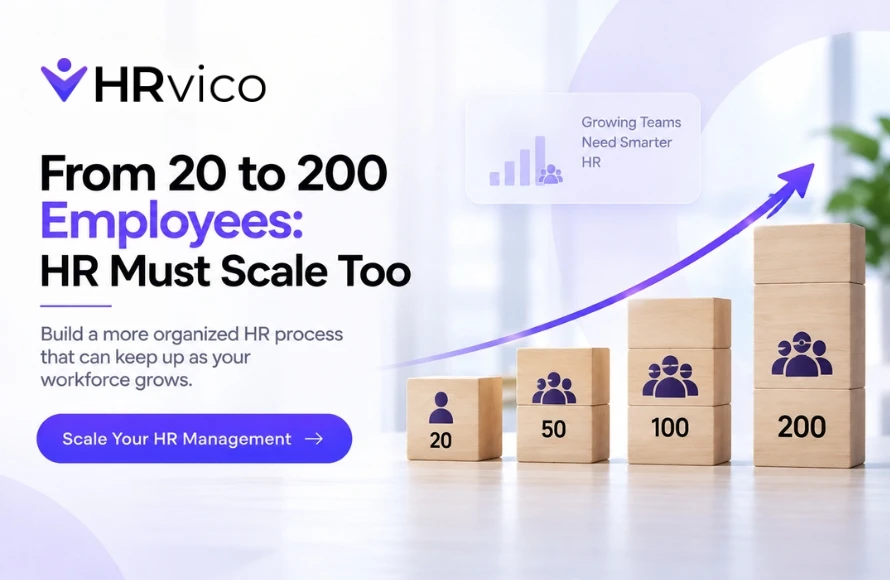
Managing HR for 20 employees can feel very different from managing HR for 200.
When a business is small, HR teams can often manage employee information through Excel sheets, emails, shared folders and direct communication. A few manual processes may not create major problems because the workforce is limited.
But as the company grows, those same processes can become difficult to maintain.
More employees mean more records, more leave requests, more documents, more attendance data, more managers and more employee queries. HR needs to move from informal processes to structured systems that can support the growing workforce.
So, how should HR management change as a business grows from 20 to 200 employees?
1. Employee Records Need to Become More Structured
With 20 employees, HR may be able to remember important details about most employees and maintain them in a simple spreadsheet.
At 200 employees, this becomes much harder.
HR needs a reliable way to manage:
✓ Employee profiles
✓ Departments and designations
✓ Reporting managers
✓ Joining information
✓ Employee documents
✓ Employment changes
✓ Work locations
A centralized employee management system can help HR maintain these records in an organized way.
2. HR Should Reduce Dependence on Multiple Excel Sheets
Excel can be useful for a small workforce, but maintaining several spreadsheets becomes increasingly difficult as employee numbers grow.
HR may have separate files for employee information, attendance, leave and reports. Updating the same information across different files can create duplicate work and data inconsistencies.
As the workforce grows, HR can consider moving core employee management processes to a centralized HR system.
3. Attendance and Leave Management Need Better Workflows
With 20 employees, HR may be able to track attendance and leave manually.
With 200 employees, handling individual requests through emails, messages and spreadsheets can become time-consuming.
A structured HR system can help employees submit requests, managers review them and HR maintain records in a more organized workflow, depending on the software's capabilities.
4. Employee Onboarding Needs to Become More Consistent
When a company hires only a few people, HR can manage onboarding individually.
As hiring increases, a consistent onboarding process becomes more important.
HR should have a clear workflow for:
✓ Collecting employee information
✓ Managing documents
✓ Completing joining formalities
✓ Communicating important information
✓ Assigning relevant tasks
✓ Tracking onboarding progress
A structured process helps ensure that every new employee receives a consistent onboarding experience.
5. Employee Documents Need Centralized Management
As the workforce grows from 20 to 200 employees, the number of employee documents grows significantly.
Storing documents across individual folders, emails and physical files can make retrieval difficult.
HR should consider a centralized approach where employee-related documents can be organized alongside employee records, with appropriate access controls.
6. Managers Need More Involvement
At 20 employees, HR may directly handle many employee-related requests.
At 200 employees, managers need to become part of everyday HR workflows.
For example, managers may need to review:
✓ Leave requests
✓ Attendance information
✓ Team employee details
✓ Certain employee updates
Role-based access can help managers access relevant information without giving them unnecessary access to other employee records.
7. Employee Self-Service Becomes More Valuable
As the workforce grows, HR can receive a large number of routine requests.
Employees may contact HR to update basic information, submit leave requests or check certain records.
Depending on the HR software, employee self-service can allow employees to handle suitable tasks themselves.
This can reduce repetitive communication and free HR to focus on more important work.
8. HR Reporting Needs to Improve
When a business has 20 employees, HR may not need complex reporting.
At 200 employees, leadership may need more visibility into workforce information.
HR may need reports related to:
✓ Employee numbers
✓ Departments
✓ Locations
✓ Attendance
✓ Leave
✓ Employee changes
✓ Other relevant HR information
Centralized data can make reporting more organized and reduce the need to manually combine information from different spreadsheets.
9. HR Processes Need to Scale With the Business
The biggest change from 20 to 200 employees is not simply the number of people.
It is the amount of HR activity generated by those people.
A process that requires 10 minutes for one employee may become several hours of work when repeated across hundreds of employees.
HR should therefore review repetitive processes and identify where technology can reduce manual effort.
10. Data Access and Security Become More Important
As employee records increase, controlling access becomes increasingly important.
Not everyone should have access to all employee information.
HR should establish appropriate permissions for:
✓ HR administrators
✓ HR executives
✓ Managers
✓ Employees
✓ Other authorized users
When evaluating HR software, organizations should review its access controls and security capabilities carefully.
What Should HR Automate as the Company Grows?
HR does not need to automate everything at once.
Start with high-volume, repetitive processes such as:
✓ Employee record management
✓ Attendance
✓ Leave workflows
✓ Document management
✓ Onboarding
✓ Employee self-service
✓ Routine reporting
The objective is to reduce administrative workload while keeping human involvement where it adds value.
What Changes Most Between 20 and 200 Employees?
The biggest difference is the need for structure and scalability.
At 20 employees, HR may be able to rely heavily on personal communication and spreadsheets.
At 200 employees, HR needs processes that are:
✓ Consistent
✓ Centralized
✓ Easier to track
✓ Less dependent on manual work
✓ Scalable
✓ Accessible to the right people
This does not mean every 200-employee company needs exactly the same HR system. The right setup depends on the organization's processes, workforce structure and requirements.
How HRVico Can Support Growing HR Teams
As businesses grow, HR needs technology that can grow with them.
Explore HRVico's HRMS features to see how employee records and everyday HR processes can be managed through a more centralized system.
Check HRVico's pricing plans to explore options based on your business requirements.
Contact the HRVico team to discuss how your organization can structure its HR processes as the workforce grows.
Explore HRVico to learn more about centralized HR management for growing businesses.